
Resilience at Work® Team
Team Resilience: A group’s collective capacity to perform optimally while maintaining wellbeing, adapt to change and setback and position for sustainable success
In today’s workforce most people work in teams, sometimes in multiple teams that may be temporary or fixed within the organisational structure. To optimise resilience this means that it is important to invest not only in individual but also in collective behaviours.
To create resilience within a group of people it makes sense that each person needs to develop their personal resilience as best they can in order to contribute as an effective member. A group of resilient people does not however guarantee a resilient team. The reason for this is that team member behaviours need to be aligned and not in conflict in order for the group as a whole to be effective. Purpose, goals and values are a good example of this. To create team resilience these need to be shared and if misaligned will impact negatively on the group’s performance. The R@W Team measures the additional factors required at a team level to build resilience.
What is the R@W Team Scale?
The R@W Team is the aspect of the R@W Toolkit that measures team resilience. It complements and builds on the R@W Scale by assessing the behaviours that create resilience in groups of people who work together.
The R@W Team has been designed to focus on actions that can be implemented by the team itself. While group-level actions can be inhibited by external demands, both within and outside of the organisation, the premise is that teams can still create a sub-culture that contributes to resilience.
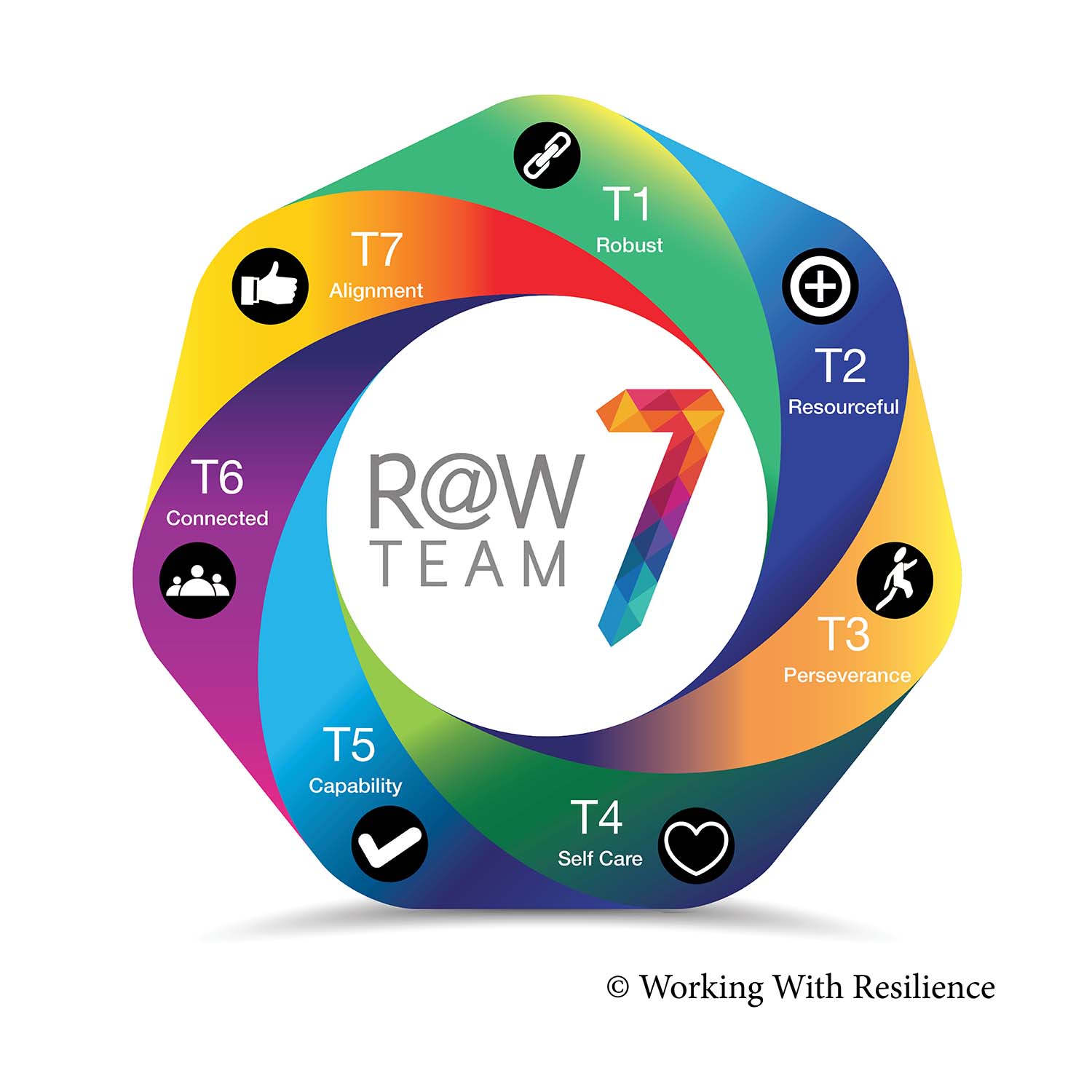

T1 Robust
Solid Intention with Agility
Having shared purpose, meaning and goals. Being adaptable to change and proactive when issues arise for the team.

T2 Resourceful
Optimising Resources and Processes
Harnessing team member strengths and resources and building a culture of continuous improvement. Developing effective team processes that enable a clear focus on priorities.
T3 Perseverance
Persisting Despite Setbacks
Persisting in the face of obstacles and having a solution, rather than a problem, focus.

T4 Self Care
Ensuring Sustainable Performance
Promoting and deploying good stress management routines and being alert to overload in members. Supporting life-work balance.

T5 Capability
Delivering in a Changing Landscape
Continually building capacity through accessing networks and supports. Seeking feedback and building on what works well.
T6 Connected
Having a Sense of Belonging
Being co-operative and supportive with each other.

T7 Alignment
Sharing Motivation for Success
Aligning to create the desired outcomes. Being optimistic, noticing progess and celebrating success.
R@W Team Benefits
The R@W Team:
• Is validated and specifically designed for the workplace
• Builds on the other aspects of the R@W Toolkit to create a systemic approach
• Considers team resilience as a dynamic state that needs continual focus
• Takes into account the impact of the organisational context in which the team is working
• Provides a comprehensive feedback report that is easily translated into practical actions
• Places emphasis on building strengths in addition to managing current and future challenges
• Is quick and easy to administer, taking only 20 minutes to compete on-line.
The Research Behind the R@W Scale
The R@W Team was developed by organisational psychologist Kathryn McEwen in collaboration with researcher Dr Carolyn Boyd. It incorporates aspects traditionally known as essential for teamwork but also includes elements that are emerging as important team behaviours for work characterised by uncertainty, complexity and pressure.